Ramiz Arshad Khan : Technologies
Showing posts with label Technologies. Show all posts

 Technology and Tools

There is a list of components which we will be using in Brain controlled robotic project depending upon its mechanical structure and electronic way of operating it using different technologies. 

The task which we are performing in our project can be performed through many different ways but we have selected and used the specific design and components depending upon the following factors.

  • Cost efficient

  • Availability

  • User friendly

As discuss in the first chapter of “beginning” we will be using following components in our project 

  • Arduino Board (Mega 2560)

  •  Robotic arm having Servo motors

  • Bluetooth ()

  • Neurosky Headset


Arduino:

Is an open source platform which can sense and control more of the physical world based on a simple microcontroller board. Arduino can be used to develop interactive objects, taking inputs from a variety of switches or sensors and controlling a variety of objects e.g. lights, motors and other physical outputs.

The Arduino programming language is an implementation of wiring, a similar physical computing platform, which is based on the processing multimedia programming environment.

There are many other microcontrollers available in market for physical computing Net media’s BX-24, phidgets, MIT’s handy board etc and many others offer similar functionality. Arduino also simplifies the process of working with microcontrollers, but it offers some advantages for teachers and students over other systems.

Arduino board is relatively inexpensive compared to other microcontroller platforms.

The arduino programming environment is easy to use for beginners yet flexible enough for advanced users to take advantage of as well.

The arduino software is published as open source tools available for extension by experienced programmer’s .The language can be expanded through C++ libraries.

Arduino Mega 2560:


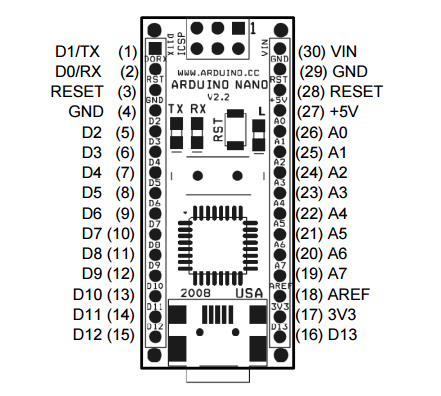
  1. Pins configuration:

           UntitledFigure 3.2

D0-D13:

The pins 1-2 and 5-16 are named as D0-D13 are I/O digital input/output from port 0 to 13.

Reset:

The pins 3 and 28 are inputs and performs the operations of reset.

Ground:

The 4 and 29 PWR pins which performs the operation of supply ground.

3V3:

It is an output which gives the +3.3v.

AREF:

Pin 18 named as AREF is the input pin which is the ADC refrence.

A7-A0:

The pins 19-26 named as A7-A0 are the analog input channel from 0 to 7.

+5V:

Pin 27 is the input or output which gives +5v output from on board regulator or +5v input from external power supply.

Vin:

The pin no 30 is the input supply voltage.

3.1.2 Arduino Mega:

Untitled123(Front view Figure 3.3)

Untitled1234(Back view Figure 3.4)

The arduino Uno is a microcontroller board based on the Atmega328.It has 14 digital input/output pins which 6 can be used as PWM outputs,6 analog inputs, a 16 MHz ceramic resonator, a USB connection ,a power jack an ICSP header and a reset button. It contains everything needed to support the microcontroller simply connect it to a computer with a USB cable or power it with a AC to DC adapter or battery to get start.


  1. Pins configuration:


CN-arduino-uno-fig1-enlarge Figure 3.5


Serial:

Pin 0 and 1used to receive (RX) and transmit (TX) TTL serial data.

External Interrupts:

Pins 2 and 3 can be configured to trigger an interrupt on a low value a rising or falling edge or a change in value.


PWM:

Pins 3, 5, 6, 9, 10 and 11 provide 8-bit PWM output with the analog write () function.

SPI:

SPI 10 (SS), 11(MOSI), 12(MISO),13(SCK) these pins support SPI communication using the SPI library.

LED:

There is a built in LED light at pin 13 when the pin has high value the light is on and when the pin has low value it would be off.

A0-A5:

The arduino Uno has 6 analog inputs named as A0 to A5 each of which provides 10 bits of resolution e.g.1024 different values.

TWI:

A4 or SDA pin and A5 or SCL pin performs TWI communication using wire library.

AREF:

This pin is the reference voltage for the analog inputs.

Reset:

Bring this line low to reset the arduino. Typically it is used to add a reset button to shields which block the one on the board.


DC Motors:

DC motor is a type of motor which converts direct current electrical power into mechanical power. There are many types of DC motors. One which we are using in our robotic arm is servo motor.
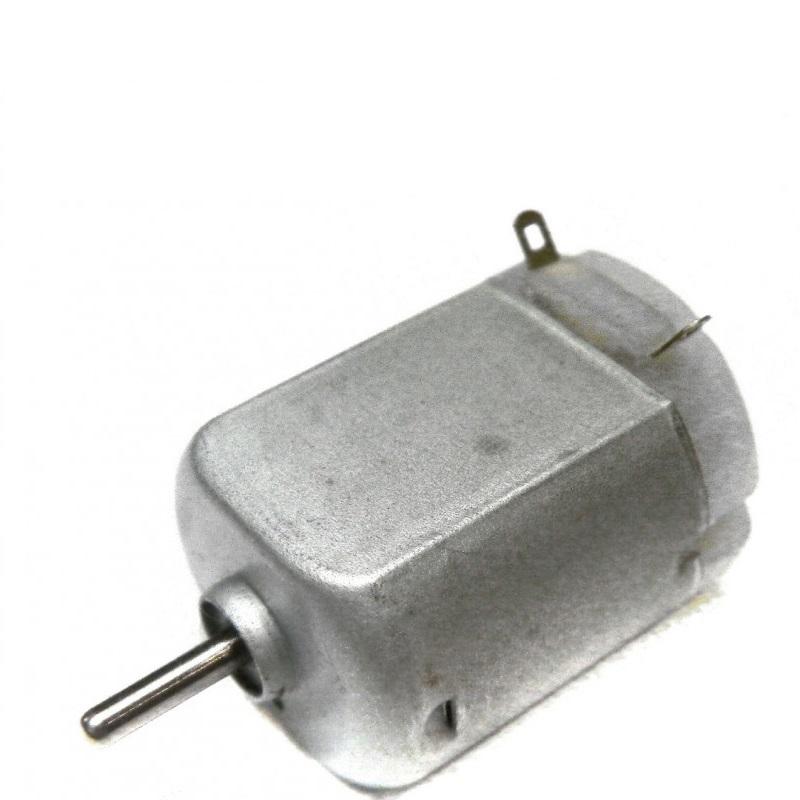
MM10 DC motor

Figure 3.6 : Simple DC motor


Servo motors: 

These are mechanical devices which are used to move output shaft, which is attached to servo wheel or arm. These are mostly used for position, velocity and torque control. Usually the shaft can move up to 180 degrees of angle.

Untitledmm

Figure 3.7

A main part of servo motor is a DC motor inside it. It also contains a potentiometer which is known as position sensor, a gear system and control electronics.

Control circuit has electronic components generally having an oscillator and controller which receives signal from sensor and signal activates the direction of the motor necessary to the position shaft in required position.

Untitlednn

Figure 3.8


 It has 3 wires. One is for power, one is for ground and one is for PWM. By sending a coded signal, we can have any position of the shaft of servo motor. It can be positioned to specific angular positions and it will remain at that position until the coded signal exists. By changing the code, we can change angular position of shaft.

Servos which we are using have 13KG/cm operating torque. It works at 100mA current. Voltage used can be from 3 to 7.2V. Operating speed is 0.17 seconds per 60 degrees at 4.8V and 0.13 seconds per 60 degrees at 6V.

Untitledkk

Figure 3.9: External View of Servo motor

Micro servo motor:

Micro Servo motor is used in the wrist. Its weight is 9g. Operating torque is 1.6KG/cm. It has plastic gear. It uses 3.5 to 6V.

Untitledmmn

Figure 3.10: Micro Servo motor

How does a servo motor work?

DC motor moves the gear system with large reduction ratio. The shaft imposes force on load and acts on the axis of a feedback potentiometer. Potentiometer senses position of axis and sends corresponding voltage to operational amplifier. Voltage compared to input voltage determines the desired position of a shaft producing voltage in output of comparator. Voltage powers motor such that a shaft moves in important direction to align with angle that is equal to the voltage applied to input.


Why we use servo motors:

We use it because it gives best accurate results.


 NeuroSky Technology  


  1. Brainwaves: 

The last century of neuroscience research has greatly increased our knowledge about the brain and particularly, the electrical signals emitted by neurons firing in the brain. The patterns and frequencies of these electrical signals can be measured by placing a sensor on the scalp. The Mind Tools line of headset products contain Neurosky Think Gear technology, which quantify the analog electrical signals, commonly referred to as brainwaves, and exercise them into digital signals. The Think Gear technology then makes those computations and signals available to games and applications. The Table I give a general synopsis of some of the commonly- identified frequencies that tend to be generated by different types of activity in the brain. 

  1.  ThinkGear 

ThinkGear is the technology inside every NeuroSky product or partner product that empowers a device to interface with the wearers’ brainwaves. It includes the sensor that touches the forehead, the contact and reference points located in the ear clip, and the on-board chip that processes all of the data. Both the raw brainwaves and the eSense Meters are computed on the ThinkGear chip. 

Table1. Frequencies Generated By Different Types of Activities in the Brain 


  1.  eSense 


eSense is a NeuroSky's proprietary algorithm for representing mental states. To calculate eSense, the NeuroSky ThinkGear technology intensifies the raw brainwave signal and removes the ambient noise and muscle movement. The eSense algorithm is then applied to the remaining signal, resulting in explicated eSense meter values. Please note that eSense meter values do not interpret an exact number, but instead describe ranges of activity. The eSense meters are a way to show how effectively the user is captivating Attention (similar to concentration) or Meditation (similar to relaxation).  


(a)Attention eSense:   

The eSense Attention meter shows the intensity of a user's level of mental “focus” or “attention”, such as that which occurs during intense concentration and directed (but stable) mental activity. Its value ranges from 0 to 100. Distractions, wandering thoughts, lack of focus, or anxiety may lower the attention meter level. 


(b)Meditation eSense:      

The eSense Meditation meter shows the level of a user's mental “calmness” or “relaxation”. Its value ranges from 0 to 100. Note that Meditation is a measure of a person's mental states, not physical levels, so simply relaxing all the muscles of the body may not instantly result in an intensified effect meditation level. However, for most people in most normal circumstances, relaxing the body often helps the mind to relax as well. Meditation is related to reduce activity by the active mental processes in the brain. It has long been an observed that closing one's eyes turns of the mental activities which process images from the eyes. So closing the eyes is often an effective method for increasing the Meditation meter level. Distractions, wandering thoughts, anxiety, agitation, and sensory stimuli may lower the Meditation meter levels. 


  1. eSense Meter:

Technical Description For each different type of eSense (i.e. Attention, Meditation), the meter value is reported on a relative eSense scale of 1 to 100. On this scale, a value between 40 to 60 at any given moment in time is considered “neutral” and is similar in notion to “baselines” that are established in conventional brainwave measurement techniques (though the method for determining a ThinkGear baseline is proprietary and may differ from conventional brainwaves). 


     A value from 60 to 80 is considered “slightly elevated”, and may be interpreted as levels tending to be higher than normal (levels of Attention or Meditation that may be higher than normal for a given person). Values from 80 to 100 are considered “elevated”, meaning they are strongly indicative of heightened levels of that eSense. Similarly, on the other end of the scale, a value Between 20 to 40 indicates “reduced” levels of the eSense, while a value Between 1 to 20 indicates “strongly lowered” levels of the eSense. These levels may indicate states of interruption, agitation, or abnormality, according to the opposite of each eSense. 


     The reason for the somewhat wide ranges for each interpretation is that some parts of the eSense algorithm are dynamically learning and at times employ some “slow-adaptive” algorithms to adjust to natural fluctuations and trends of each user, accounting for and compensating for the fact that brainwaves in the human brain are subject to normal ranges of variance and fluctuation. This is part of the reason why ThinkGear sensors are able to operate on a wide range of individuals under an extremely wide range of personal and environmental conditions, while still giving good accuracy and reliability. 

Learn Tool and Technologies we have used in this project

click here


 Introduction:

In this modern age we are mostly dependent on machines than ever before in our lives. Robotics is a current emerging technology in the field of science. A number of Universities in world are working in this field. These days many types of wireless robots are being developed and are put to varied applications and uses. The purpose of this project is to develop a robotic arm, which is operated & controlled wirelessly with the help of Neurosky Headset which transmits signals to the robotic arm through an arduino rather than controlled it manually through a conventional remote controller. The Robot moves and acts in the manner depending on the brain signals judged by the Neurosky Headset. The robot moves in up, down, left or right directions and picks up objects from one place and keeps at another desired place as directed by the brain signals which is wirelessly controlled through Bluetooth devices.

Our project consists of two different parts. First one is the mechanical structure for the Robotic arm and other one is the Neurosky headset which operates the Robotic arm. The Robotic arm consists of servo motors which interfaced with Arduino and Bluetooth. 


1.2 Robotic Arm:

Robotic arm is a mechanical arm which is usually programmable with having similar function as a human arm. It consist of many servo motors or any other of this type.


Development Of Robotics:

It is a new branch of engineering. It contains different fields of engineering. Different branches occupied are:-

  1. Mechanical Engineering: It is because of the structure of the Robots and the machines.

  2. Electrical Engineering: It is because robot uses electronics for controlling and intelligence.

  3. Computer Engineering: It is because of the observation process and it deals with the development of movement. 

Classification of Robots:

Its categories are made by looking at the circuits and the applications. There are three categories of robots.

  • Simple robots:

These do not contain any complex circuit and are basically helps the humans in work. For example a washing machine is also a robot which is automatic machine.


  • Middle Robots:

These are those robots which are once programmed then they can never be programmed again. They can perform many tasks and they contain sensors. For example is automatic washing machine.


  • Complex Robots:

They can be programmed many times. They have complex circuits for example laptops and computers.


1.4 Applications of Robots:

  • Outer Space :

Robots used in space.

  • The Intelligent Home :

These robots help the people to enjoy home appliances. Like door and windows can be opened and closed automatically. Lights and other electronic appliances can be turned off and on automatically.

  • Exploration :

These can go in areas which are injurious to humans.

  • Military Robots : 

These are like drones and are very helpful.

  • Farms : 

These can be used in farms to collect crops.

  • The Car Industry :

These are used in assembling procedures.


In this modern age, we are mostly dependent on machines than ever before in our lives. In this report we are developing the Robotic arm, which is controlled wirelessly with the help of Neurosky Headset. The project is made in two parts. One is Robotic arm having 5 servo motors used as a receiver and the other one is a Neurosky headset which obtains brain signals i.e alpha, beta, gamma, theta etc which is interfaced with Arduino. Bluetooth device is used on transmitting and receiving end. Each motor is moved by different angles with brain signals.